
I was stunned today by the Facebook post showing Kumi Naidoo, head of Greenpeace, shaking hands with Franceso Starace, the new CEO of Enel, one of Italy’s largest energy utilities. Like Germany’s EON SE, Enel is committing to closing 23 coal-fired power plants in Italy and cancelled plans to build two new ones, one in Italy and one in Chile. Both companies have clearly taken a long-term strategic view and taken into account that while the costs of coal and nuclear are rising everywhere, the costs of renewables are dropping fast. Unlike ESKOM, they both have to worry about profits to survive and realize, therefore, that repairing rather than destroying the planet makes good business sense. ESKOM’s recent announcement that it will stop supporting the growth of the renewable energy sector stands in direct contrast to this far-sighted strategy of companies that are in the same business as ESKOM. And if one considers the facts, ENEL and EON SE must be right. Renewable energy expanded at its fastest rate ever in 2014
(Source: International Energy Agency 2015)
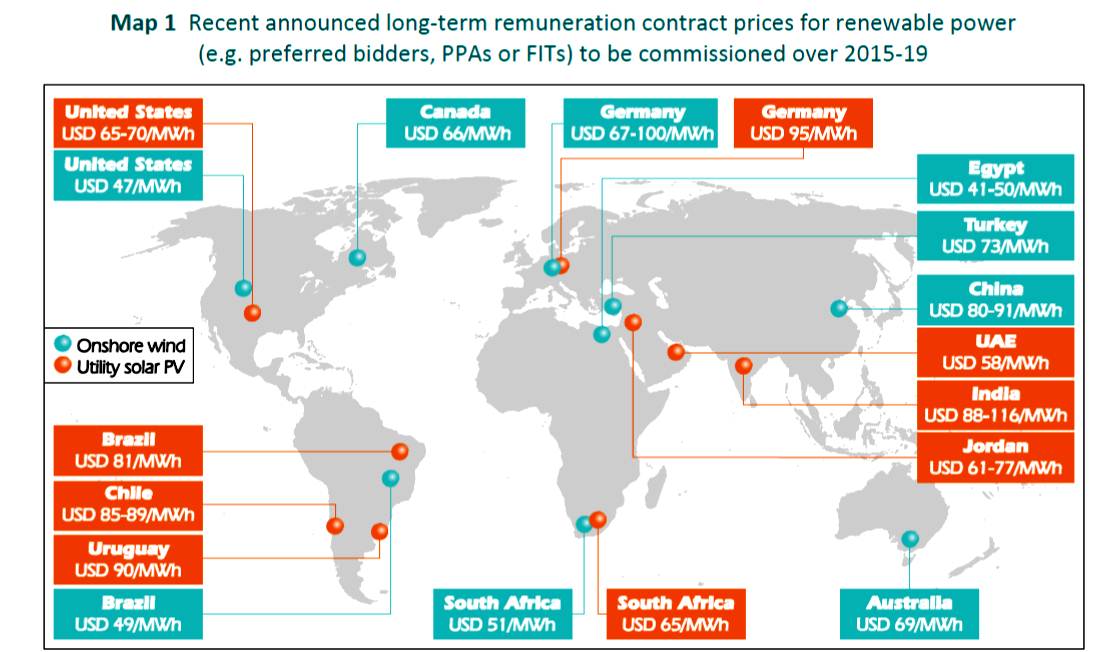
(130 GW), despite the decline in oil prices which many predicted would halt the extra-ordinary growth in renewables world-wide. Renewables accounted for more than 45% of net additions to world capacity in 2014. Based on current trends, renewables which accounted for 22% of total capacity in 2013 are expected to rise to 26% in 2020. In other words, two thirds of net additions to power capacity by 2020 will be renewables (International Energy Agency 2015). Wind power now globally costs the same as coal power. The above prices need to be seen in the context of average prices for coal-fired electricity in 2015: increasing from $66 per MWh to $75 in the Americas, from $68 to $73 in Asia-Pacific, and from $82 to $105 in Europe. Given the rising real cost of Medupi (from R70 billion initially, to R300 billion in the end, according to some well-informed people), renewables are effectively at grid parity per MWh in South Africa. As far as investment trends are concerned, 2014 was the fifth consecutive year that investment in renewables exceeded investment in new fossil fuel-based energy – by 2014 it was up to USD 242.5 b compared to the USD 132 b invested in new fossil-fuel based capacity in the same year (International Energy Agency 2015). What really hit me hard is a statement by Starace that conventional fossil fuels and nuclear power plants are “a trap … A trap for companies to die.” What does he mean? He is referring to massive risks involved in large projects – “Big is bad”, he said, “Our strategy is much more flexible and modular than it was before, and more adaptable to the world we live in.” Now I understand something that has puzzled me since looking closely at who got the awards in Round Three of the REIPP. ENEL was awarded nearly 300 MW across a number of projects dwarfing by far all the other bidders. This is a massive amount of renewable energy. Why did they do so ‘well’? Well, to put it simply, as a corporate they could borrow against their large balance sheet and secure global finance rather than access more expensive project finance from local banks, and as a large company it can probably secure more attractive prices from equipment suppliers. This is what made it possible for them to undercut the prices of competitors and contributed to the lowering of the cost of renewable energy in South Africa. The down side is local players got squeezed out and more of the profits can get repatriated. But what I have now realized is that this is part of a global strategy by ENEL to become a dominant player in the renewable energy sector globally, taking advantage of the rapid transition to renewable energy taking place globally. As already suggested this is good and bad for South Africa: good in that renewable energy prices are pushed down, bad because it means a global corporate takes control of a sector that could be locally owned and decentralised. At least two renewable energy plants are locally owned by community trusts. Would this not be a better option? So there we have it: welcome to the political economy of the new world of renewable energy expansion and growth. And hey, maybe we should ask for Kumi Naidoo’s strategic advice – after all, he is a South African!
Mark – Excellent article. Now we have to change course in SA. Lots of +ve work on real green. But Nuclear, with tears in my eyes!